


 English
 Español
Payday Alternative Loans: $43.51 vs $450 to Borrow $500 for 3 Months
Payday alternative loans (PALs) are small loans a federal credit union can make under a rule from the National Credit Union Administration (NCUA), the federal regulator and insurer of credit unions. That rule, 12 CFR 701.21 in the Code of Federal Regulations, caps a PAL at 10 points above the NCUA's current 18% loan-rate ceiling, or 28% APR, plus an application fee of no more than $20. At both maximums, my math puts a $500 PAL repaid over three months at $43.51 in total cost. The same $500 from a payday lender charging $15 per $100 for two weeks, the typical fee in a Consumer Financial Protection Bureau (CFPB) factsheet, costs $450 in fees once you've renewed it for 12 weeks.
Stretch the PAL to six months, the longest PAL I term, and the total comes to $61.62, which is less than the $75 fee on a single two-week payday loan of the same size. Two things can rule you out. PAL I requires at least a month of membership before the credit union can lend, and the NCUA rule lets federal credit unions offer PALs without requiring any to.
What the NCUA Rule Allows in a Payday Alternative Loan
Two PAL programs sit in the same rule. PAL I came first; PAL II took effect on December 2, 2019, and the final rule that created it says PAL II "does not replace the NCUA's current PALs rule". A credit union can offer one, both or neither. Here is how they compare in the rule text at Cornell's Legal Information Institute and in that final rule:
- Loan amount: PAL I runs from $200 to $1,000. PAL II allows "not more than $2,000" and sets no minimum.
- Term: PAL I runs from one to six months. PAL II requires "a minimum maturity of one month and a maximum maturity of 12 months."
- Membership before borrowing: PAL I requires the credit union to set a minimum of at least one month. PAL II has no federal minimum, though the credit union may set one of its own.
- Rate cap: both allow up to 1,000 basis points above the maximum rate the NCUA Board sets, which works out to 28% today.
- Application fee: both limit it to the actual cost of processing your application, and never more than $20.
- Overdraft and NSF fees: a PAL II lender can't charge you an overdraft or non-sufficient funds (NSF) fee through its overdraft service in connection with the loan. That ban belongs to PAL II only.
PAL I: $200 to $1,000 after one month of membership
On MyCreditUnion.gov, the NCUA's own consumer page, last modified February 4, 2025, describes PAL I ($200 to $1,000, one to six months, one month of membership) and never mentions PAL II. Read it alone and you'd assume every PAL comes with a month-long wait. For PAL I, that month is a floor written into the rule itself. If you aren't a member anywhere yet and need the money before that month is up, PAL I is off the table for this round.
PAL II: up to $2,000 with no federal waiting period
PAL II raised the ceiling to $2,000, stretched the longest term to 12 months and dropped the federal membership wait. Its final rule's preamble says a federal credit union "may make such a loan immediately upon the borrower establishing membership". The same preamble adds that the rule "does not prohibit a credit union from setting a minimum membership term," so a PAL II lender can still make you wait. Ask about that before you fill out a membership form.
Limits that apply to both programs
Both programs share these limits, and the first two count PAL I and PAL II loans together, per the final rule and the current rule text:
- Three per rolling six months: a federal credit union "does not make more than three payday alternative loans" to you in any rolling six-month period, with both programs counted together.
- One at a time: it can make you only one PAL at once, again counting both programs.
- No rollovers: the credit union "does not rollover any payday alternative loan." It may extend the term within the program's maximum if it charges no additional fee and extends no new credit.
- Full amortization: the credit union "fully amortizes the payday alternative loan," so the last scheduled payment clears the balance.
What a $500 PAL Costs Next to a Payday Loan
Because the rule caps both the rate and the fee, you can price the worst case on these alternative payday loans before you walk in. My numbers assume the full 28% rate and the full $20 application fee, interest charged monthly on the declining balance, and every payment made on time. Your credit union may charge less or accrue interest daily, so its figures can differ by cents or more.
The PAL payment, worked step by step
One formula covers every term. In words: the payment equals the amount borrowed times the monthly rate times a growth factor, all divided by the growth factor minus 1, where the growth factor is 1 plus the monthly rate, raised to the number of payments. Here it is on $500 over three months:
- Monthly rate: 0.28 / 12 = 0.02333333.
- Growth factor: 1.02333333 x 1.02333333 x 1.02333333 = 1.07164603.
- Top line: 500 x 0.02333333 x 1.07164603 = 12.502535.
- Payment: 12.502535 / 0.07164603 = $174.5042, or $174.50 a month.
Here's the split, at four decimals so every line checks:
- Month 1: interest 500.0000 x 0.02333333 = 11.6667; principal 174.5042 - 11.6667 = 162.8375; balance 337.1625.
- Month 2: interest 337.1625 x 0.02333333 = 7.8671; principal 166.6371; balance 170.5254.
- Month 3: interest 170.5254 x 0.02333333 = 3.9789; principal 170.5253, which clears the balance to within a hundredth of a cent.
Total interest is 11.6667 + 7.8671 + 3.9789 = 23.5127, or $23.51. Add the $20 application fee and the PAL costs $43.51, so you repay $543.51 in all, which works out to $43.51 / 5 = $8.70 per $100 borrowed for three months. If your lender rounds the payment to $174.50, the last payment absorbs the difference, which can move the interest total by a cent.
The same $500 as a payday loan, once and rolled over
I won't walk through how a payday loan works or why $15 per $100 works out to 391% APR, since both have their own guides on this site. The CFPB's 2013 payday factsheet puts the typical storefront fee at $15 per $100 borrowed for two weeks. On $500, that's 5 x $15 = $75, and you owe $575 on day 14.
To match the PAL's three months, count 12 weeks, six two-week terms, which falls about a week short of three months and so, if anything, understates the payday cost. Pay the $75 and renew each time, and the fees come to 6 x $75 = $450 before you repay the $500, or $950 out of pocket. That's more than 10 times the PAL's $43.51 ($450 / $43.51 = 10.34), and you've paid six times to borrow the same $500 once.
Those renewal figures assume a lender that lets you roll the loan over. Many states cap or ban rollovers, so check your state's payday fee cap before you lean on this comparison.
Cost by term, PAL against payday
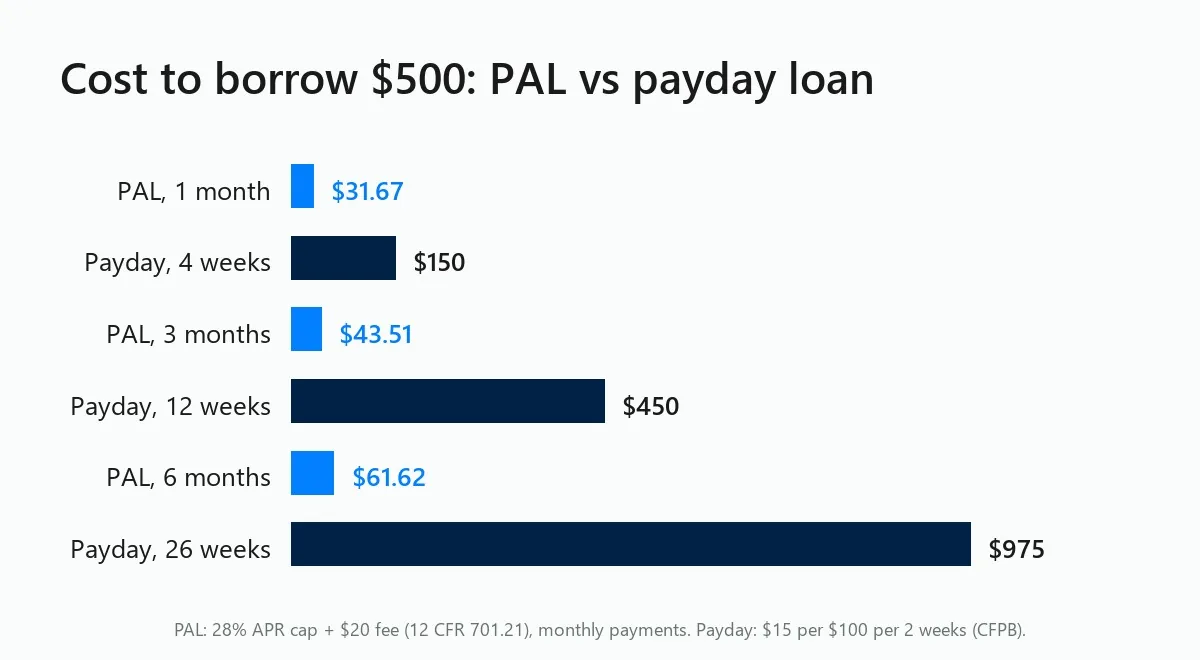
Same $500, the PAL at the 28% cap with the $20 fee inside every total, the payday loan at $75 per two-week term. Payday loans run in two-week blocks and PALs in months, so the pairs don't line up exactly: 1 month sits against 4 weeks, 2 months against 8 weeks, 3 months against 12 weeks and 6 months against 26 weeks.
- 1 month: one PAL payment of $511.67, interest $11.67, total cost $31.67. Payday loan held 4 weeks (2 terms): $150 in fees.
- 2 months: PAL payments of $258.78, interest $17.57, total cost $37.57. Payday loan held 8 weeks (4 terms): $300 in fees.
- 3 months: PAL payments of $174.50, interest $23.51, total cost $43.51. Payday loan held 12 weeks (6 terms): $450 in fees.
- 6 months, the PAL I maximum: PAL payments of $90.27, interest $41.62, total cost $61.62. Payday loan held 26 weeks (13 terms): $975 in fees.
For one month, interest is 500 x 0.02333333 = $11.67 on a single $511.67 payment. Two months uses a growth factor of 1.04721110 and a $258.7836 payment (2 x 258.7836 = 517.5672), and six months uses 1.14842521 and a $90.2697 payment (6 x 90.2697 = 541.6182).
What the 28% cap and the $20 fee cover
The 28% is arithmetic stacked on another cap. Section 701.21 starts from a 15% yearly ceiling on federal credit union loans, inclusive of all finance charges, and lets the NCUA Board set a higher one, which it must review at least every 18 months. The Board's current ceiling is 18%, extended through September 10, 2027, and PALs get 1,000 basis points, or 10 percentage points, on top: 18% + 10% = 28%. If the Board moves the 18%, the PAL cap moves with it.
Your application fee sits outside that 28% only while it matches the actual processing cost, because the PAL II final rule says "An application fee that exceeds the actual cost of processing a borrower's application is a finance charge". That's why my cost list adds the $20 on top of the interest.
Who Can Get a Payday Alternative Loan
Start with the charter. Section 701.21 "generally applies to Federal credit unions only", and the PAL authority is written for federal credit unions. On the state side, the NCUA says "Many state-chartered credit unions offer products similar to PALs", and state law sets their terms, so none of the caps in this article are guaranteed there.
Next comes availability. Offering PALs is optional, since the rule gives federal credit unions permission to make them and orders none to do it. The latest count I can point to sits in the 2019 PAL II final rule and uses December 2018 data: 606 federal credit unions reported offering PAL I loans, with 211,589 loans outstanding and an aggregate balance of $145.2 million.
Then you have to qualify. The rule requires underwriting guidelines and gives two recent pay stubs to verify employment as its example, but each credit union sets its own approval standards, inside the one-at-a-time and three-in-six-months limits above.
How to Find a Credit Union That Offers PALs
The NCUA's consumer page on payday loan alternatives links to the NCUA's credit union locator and tells you to contact your local federal credit union. Whether a particular credit union makes PALs is a question for that credit union, so plan on making calls. Work through it in this order:
- Open the NCUA's credit union locator from that MyCreditUnion.gov page and list the credit unions near you.
- Call each one and ask whether it holds a federal or a state charter, since the PAL rules cover federal credit unions.
- Find out whether it offers PAL I, PAL II, both or neither, and how long you must be a member before you can borrow. PAL I means at least a month; for PAL II it's the credit union's call.
- Get the rate and application fee it actually charges, which can sit below the caps, then rerun the payment steps above with its numbers or use the installment and rollover calculators.
- Ask what its underwriting needs from you, then join and apply. Pay stubs are the rule's example, so have recent ones handy.
When a PAL Is the Better Call and When It Comes Too Late
On cost, a PAL wins at every term I priced. Even the six-month version at the full caps, $61.62, beats one two-week payday fee of $75 on the same $500, and the three-month version costs less than a tenth of what 12 weeks of renewals would. If you can get a PAL before the bill is due, take it.
You're better off with a PAL when all of these hold:
- You belong to a federal credit union that offers PAL I and you've been a member long enough to meet its PAL I wait, which is at least a month; or a federal credit union you can join offers PAL II and sets no wait of its own.
- The amount is $2,000 or less, or between $200 and $1,000 if PAL I is the only program on offer.
- Monthly installments over one to 12 months (one to six for PAL I) fit your budget.
- No PAL is outstanding with that credit union, and it hasn't made you three in the past rolling six months.
It comes too late, or not at all, when any of these apply:
- You aren't a member anywhere and the nearby federal credit union offers only PAL I, which requires at least a month of membership first.
- The credit union doesn't offer PALs, and no rule makes it.
- You already have a PAL out with that credit union, or it has made you three in the past rolling six months.
- Your credit union is state-chartered and its similar product falls outside this rule, so you have to price it on its own terms.
In those cases, compare other small-loan options and what each costs before you sign a payday agreement. If a PAL is within reach, here's what it means for your next paycheck: the payday loan wants $575 back on day 14, and the three-month PAL wants $174.50 a month, three times.
Frequently Asked Questions
Can I get a PAL the day I join a credit union?
Only a PAL II, and only if that credit union allows it. The PAL II final rule says a federal credit union "may make such a loan immediately upon the borrower establishing membership", and each credit union can still set its own minimum. For PAL I, 12 CFR 701.21 requires at least a month of membership first.
Is the $20 application fee part of the 28% APR?
No, as long as the fee reflects the actual cost of processing your application and stays at or below $20. The PAL II final rule treats an application fee above actual cost as a finance charge that counts against the rate ceiling. So a compliant fee of up to $20 is a separate cost added to the interest.
How many payday alternative loans can I have?
A federal credit union can make you one PAL at a time and no more than three in any rolling six-month period. Both limits count PAL I and PAL II together, so holding one of each from the same credit union at once is off the table. Each credit union also applies its own underwriting standards.
Can a PAL be rolled over or extended?
Rolled over, no: both PAL programs bar it, and the PAL II text says a federal credit union "does not rollover any payday alternative loan". Extended, possibly. The rule lets a credit union stretch the term within the program's maximum if it charges no additional fee and extends no new credit, though it doesn't have to agree.
Will the 28% cap change?
It can. The PAL cap sits 1,000 basis points above the NCUA Board's loan-rate ceiling, which is 18% and runs through September 10, 2027, after the Board extended it in February 2026. Under the rule, the Board must review that ceiling at least every 18 months, and the PAL cap moves with it.
Not a lender. Cost figures use the federal APR formula and the state rule named next to them; the state pages cite each statute. Full disclosures.