
Instant $100 Cash Advance: What $100 Costs for Two Weeks
Small amount, small fee, same rules as a bigger loan. Here's what $100 costs, how fast it lands, and when a free route beats a lender.
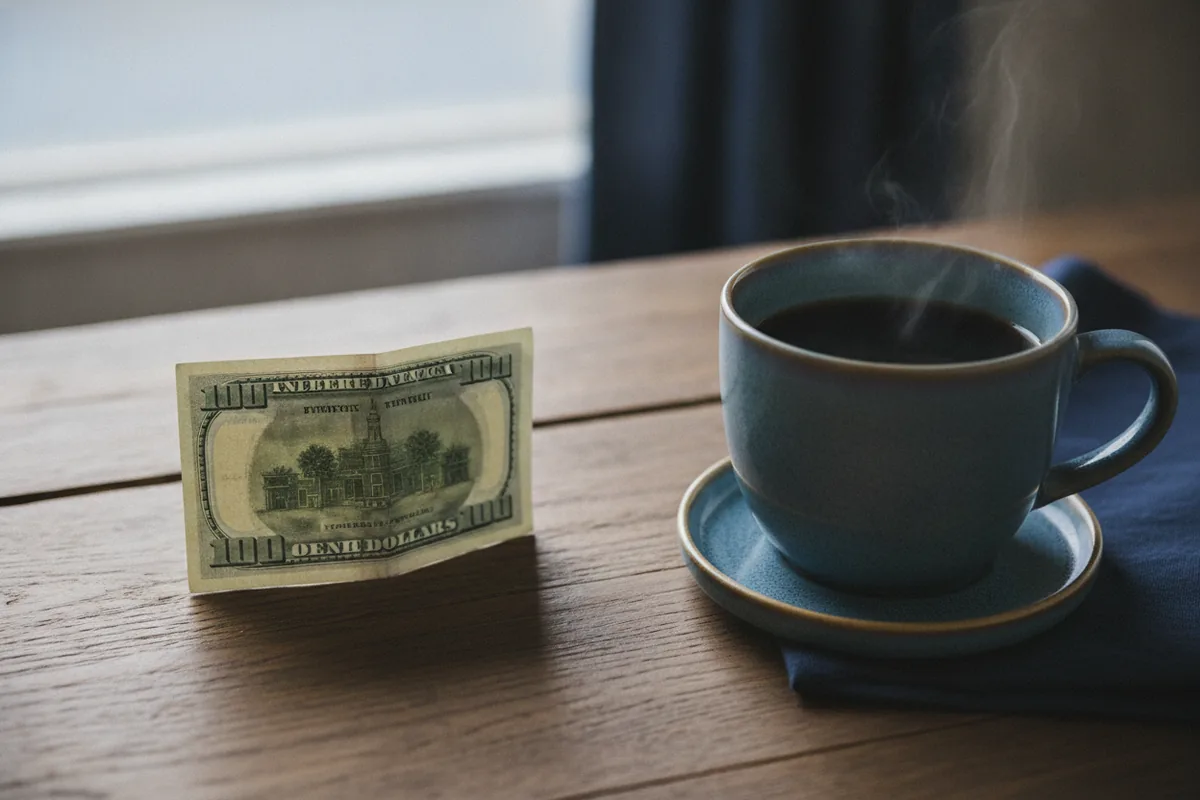
Short answer: an instant $100 cash advance is the smallest short-term loan most lenders offer. You qualify with steady income, an active checking account and legal age in a state that allows it. The fee is set by state law, from about $1.38 in a 36% cap state to $20 in Mississippi, and the deposit usually arrives the next business day.
Why $100 Is Harder to Borrow Than It Sounds
A hundred dollars is the amount most people actually need. The car needs gas until Friday, the phone bill autopays Thursday, the copay is $85. It's also the amount lenders like least. Their cost to verify you, fund you and collect from you is about the same on $100 as on $400, so many set a $200 or $300 floor, and the ones that do offer $100 charge the highest fee per $100 their state allows.
That's why the APR on a $100 advance looks identical to the APR on $300. The fee scales with the amount, and so does the annualized rate. What changes is the dollar figure. Fifteen dollars is easier to absorb than $45, which is the whole argument for borrowing only what you need instead of rounding up to be safe.
One more thing worth knowing. Some request forms start at $100, but the lender that answers may come back with a $200 or $250 minimum. You can decline. An offer is not a commitment until you sign it.
How to Request an Instant $100 Cash Advance
- Ask for $100, not more. The form lets you pick the amount. Fees scale with the number you type.
- Fill in the rest. State, how you're paid and when, the checking account for the deposit. About five minutes on a phone.
- Wait for the decision. Automated review of your income deposits, usually minutes in business hours. Requests go only to lenders licensed for your state.
- Read the offer. Fee, APR, due date, total to repay. If the minimum came back higher than $100, this is where you say no.
- Sign and get paid. Electronic signature, then an ACH transfer that normally posts the next business day. Same-day for a fee where a lender offers it.
What a $100 Cash Advance Costs by State
Short-term lenders charge a flat fee per $100 borrowed, and your state sets the ceiling. Because the loan lasts two weeks, the fee annualizes into a large APR. Same $100, same 14 days, four prices.
| State rule | Fee | You repay | APR |
|---|---|---|---|
| 36% APR cap states (Illinois, Colorado, others) | $1.38 | $101.38 | 36% |
| Florida ($10 per $100 plus a $5 verification fee) | $15 | $115 | 391% |
| Alabama (17.5% of the amount advanced) | $17.50 | $117.50 | 456% |
| Mississippi ($20 per $100 on advances up to $250) | $20 | $120 | 521% |
APR = fee divided by amount, times 365, divided by days. Mississippi: 20 / 100 x 365 / 14 = 5.21, or 521%. In states with no fee cap the lender picks the number; the CFPB puts the typical range at $10 to $30 per $100, so budget for $110 to $130 back on a two-week loan.
The cash advance calculator turns any fee and term into an APR and a total, and the state hub lists the cap for every state with the statute behind it.
Cheaper Ways to Get $100 Before Payday
For $100 specifically, a lender is often the fourth-best option. Check these first; they take about as long as the request form.
- Your employer. Many payroll departments will advance part of an earned paycheck at no charge. It costs one awkward email.
- A paycheck advance app. Some charge a flat fee for an instant transfer, some ask for an optional tip, some are free through your employer. Even a $5 fee on $100 for 14 days is 130% APR, but $5 is a third of a payday fee.
- A credit union PAL. Payday alternative loans cap APR at 28%. PAL I starts at $200; PAL II has no minimum, so $100 is possible if your credit union offers it.
- The biller itself. Utilities and phone carriers routinely move a due date by a week or two if you call before it passes. A bill that moves is $100 you don't borrow.
Overdraft is the trap. Letting a $100 payment bounce into overdraft can cost as much as a payday fee, and the bank may charge it more than once. If the choice is overdraft or a $15 advance, the advance is usually the cheaper mistake.
Who a $100 Cash Advance Fits, and Who It Does Not
It fits a one-off, one-cycle gap: the copay is due Tuesday, the paycheck lands Friday, the fee is $15 to $20 and you can see it on the screen. You'll pay it once and be done.
It doesn't fit a $100 hole that opens every month. A fee that repeats twelve times is $180 to $240 a year for the privilege of borrowing your own next paycheck. That pattern is cheaper to break with a small installment loan repaid over a few months, a PAL, or a call to 211 for help with the bill that keeps causing it.
Rules That Change by State
Your state decides whether the product exists at all, what it can cost and how long it can run. In the 36% cap states a two-week $100 advance costs $1.38 and most lenders don't bother; what you'll be offered there is a small installment loan instead. Florida, Alabama and Mississippi allow the product with the caps in the table. A handful of states set no cap, and several run a database that blocks a second loan while one is open.
Before you ask, check the cash advance rules for your state: maximum amount, fee cap, regulator contact and a worked example, each tied to the statute.
Frequently Asked Questions
How fast can I get an instant $100 cash advance?
The decision usually comes back within minutes during business hours, because the lender's system reads your bank activity automatically. The $100 itself moves by bank transfer and normally posts the next business day. Some lenders offer a same-day transfer for an added fee, which the offer shows before you accept. On a $100 loan, check that fee closely: it can be a large share of the amount.
Is there a credit check for a $100 cash advance?
There's no hard credit check to request one. Submitting the form triggers at most a soft inquiry, which doesn't touch your score. Lenders decide mostly on your income deposits and bank history. A few run a hard pull only if you accept their offer, and the offer says so before you sign. A low score usually means a higher fee or a smaller amount, not an automatic no.
What is the cheapest way to borrow $100?
Usually not a payday lender. An advance from your employer often costs nothing. A paycheck advance app may charge a few dollars or an optional tip. A credit union PAL II has no minimum amount and caps APR at 28%. A payday-style advance is the fastest of the four and the most expensive per dollar, so use it when the cheaper routes are closed or too slow.
Can I get $100 if I am paid in cash or through gig work?
Yes, if the income shows up in your bank account. Lenders read deposits, not pay stubs, so gig payouts and benefits count as long as they land regularly. Cash income that never gets deposited is hard for an automated system to verify, and the request may be declined or sized down. Depositing your pay for a couple of months before you ask helps more than anything else.
What happens if I cannot repay $100 on the due date?
Call the lender before the date. Some states require a no-cost extended payment plan if you ask before default; others allow one rollover for a new fee. On $100, a rollover in a $15 per $100 state adds $15 every two weeks, which is how a small loan turns into a large one. If the shortfall is going to repeat, a monthly installment loan or a credit union PAL is the cheaper fix.
Related Options
 Instant cash advanceDecisions in minutes, funding usually next business day.
 Cash advance nowThe fastest honest path from request to deposit.
 Same day cash advanceRequesting before the cut-off so the deposit lands today.
 $500 cash advanceWhat $500 costs for two weeks in your state.
 Small payday loans online$100 to $500, requested online, no hard credit check to ask.
 Payday alternative loansCredit union PALs, employer advances and other cheaper routes.
Sources
- CFPB: What is a payday loan?
- Florida Statutes 560.404: deferred presentment transactions
- Alabama State Banking Department: Deferred Presentment Services Act
- Mississippi Department of Banking and Consumer Finance: Check Cashers Act
- Regulation Z, 12 CFR 1026.22: determination of annual percentage rate