


 English
 Español
Cash Advance Without a Bank Account: Your Real Options

You can get a cash advance without a bank account in some cases, most directly by using a prepaid card account in its place. The Consumer Financial Protection Bureau (CFPB) lists what you need to qualify for a payday loan, and the list includes "An active bank, credit union, or prepaid card account." Lenders want that account for two jobs: paying you, and later collecting from you.
With no account of any kind, the field gets smaller. The CFPB's explainer on what a payday loan is says the money can come in cash, yet repayment runs through a post-dated check or a debit from an account. That mostly leaves a check casher, if you already hold a paycheck, and loans backed by property, such as pawn and car title loans.
If a bank account costs more than you can carry right now, you have plenty of company. The Federal Deposit Insurance Corporation (FDIC) household survey found that 4.2% of US households, about 5.6 million, were unbanked in 2023, and the most common main reason they gave was "Don't have enough money to meet minimum balance requirements." That makes this a cost problem, so compare every route below on price and on what it can take from you.
What a Lender Checks When You Have No Bank Account
Besides the account, the CFPB's list covers income and identification, and the full eligibility checklist lenders run goes through those documents one by one. For the credit side, see what lenders check instead of your credit score.
On income, the wording is broad: "Proof or verification of income from a job or other source." For someone who is unbanked, the account line is the hard one, and the reason is how the money moves.
Why the account matters: how you get paid and how they collect
The CFPB's payday loan explainer covers both directions. Going out, "Money from the loan can be given in cash, by check, through an electronic deposit, or on a prepaid card." Coming back, you either write a post-dated check for the full balance including fees, or you authorize the lender to debit "the funds from your bank, credit union, or prepaid card account."
Payout, then, has options that need no account. Repayment mostly doesn't: a check is drawn on a checking account, and a debit comes out of whatever account you named. If you don't pay, the CFPB says the lender cashes the check or withdraws the money electronically, and with loans generally "for $500 or less" that come due "typically two to four weeks" after you borrow, that moment arrives quickly.
What happens when a withdrawal fails
Say the due date comes and the balance is short. The CFPB's payday lending rule at 12 CFR 1041.8 covers payday loans and certain longer, high-cost loans repaid from your account, and it treats a payment returned for insufficient funds as a failed transfer. After two failures in a row, "A lender must not initiate a payment transfer from a consumer's account" without your new authorization, and "the specific date, amount, and payment channel of each additional payment transfer must be authorized by the consumer."
You can also stop a scheduled electronic payment yourself by telling your bank or card provider. Regulation E (12 CFR 1005.10), the federal rule covering electronic fund transfers, lets you stop a preauthorized transfer "by notifying the financial institution orally or in writing," as long as you do it "at least three business days before the scheduled date of the transfer." If you call, your bank or card provider may require written confirmation within 14 days. A stop order covers the withdrawal only, so contact the lender about the balance too.
Cash Advance With No Direct Deposit: You Still Need an Account
No direct deposit and no bank account are two separate problems, and the first is easier to solve. The CFPB's payday requirements never mention direct deposit, and nothing in the income line says your pay has to arrive that way. What the list does need is an account.
Cash advance apps can be stricter about that account than the CFPB's list is. MoneyLion's published terms for Instacash require a linked checking account that has been open at least two months, where you regularly deposit your income, with a consistently positive balance. Savings and money market accounts don't qualify.
So for cash advance loans without direct deposit, the account question comes first. Anyone with a checking account should read each app's own published terms before linking it; without one, the routes below are what's left.
Routes That Work Without a Checking Account
Four routes remain: a prepaid card account in place of checking, a storefront that pays out in cash or by check, a check casher for a check you already hold, and a pawn or title loan secured by something you own. What you put up decides what you can lose.
A prepaid card account
This is the closest substitute, since the CFPB's two explainers name prepaid card accounts at every step: as a qualifying account, as a way to receive the loan, and as an account the lender can debit for repayment.
Before you apply, ask whether the lender takes a prepaid card for the payout and plans to debit the same card on the due date. If rent or a phone bill also comes off that card, the loan payment competes with them for the same dollars.
A storefront that pays cash or check
A storefront lender can hand you the money in cash or by check, both payout methods the CFPB describes. Repayment brings the account back in: a post-dated check needs a checking account behind it, and a debit authorization needs some account to pull from, prepaid included.
The loan itself is expensive. In its explainer on payday loan annual percentage rates (APRs), the CFPB works through a fee of $15 per $100 borrowed for two weeks and says it "equates to an APR of almost 400 percent." The exact math is $15 / $100 x 365 / 14 = 3.911, or about 391% APR. Whether a storefront can make the loan at all depends on your state, and the license check below shows how to confirm it.
A check casher for a check you already hold
If what you have is a paycheck or a benefits check and nowhere to deposit it, a check casher turns it into cash for a fee. You borrow nothing, so no due date or debit waits for you afterward.
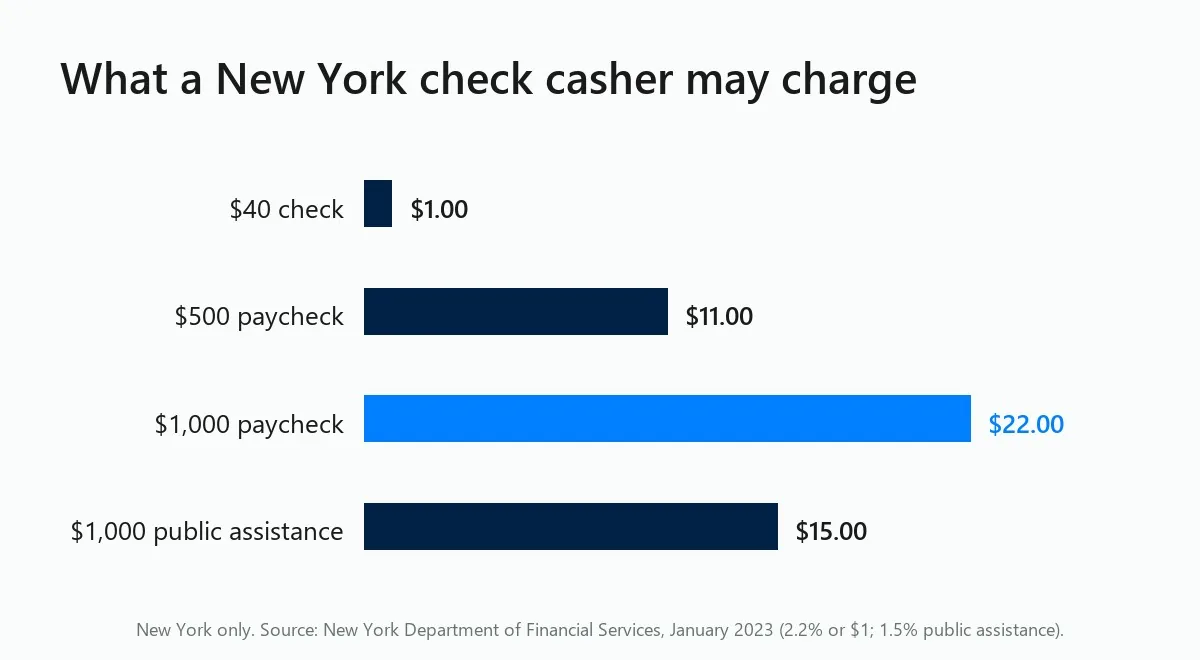
New York caps that fee. The state's Department of Financial Services announced its caps in January 2023: 1.5% for public assistance checks from a federal or state agency, and "2.2% or $1, whichever is greater" for all other checks. At those caps, a New York check casher may charge at most:
- A $40 check: $40 x 0.022 = $0.88, which is under the floor, so the cap is $1.00
- A $500 paycheck: $500 x 0.022 = $11.00
- A $1,000 paycheck: $1,000 x 0.022 = $22.00
- A $1,000 public assistance check: $1,000 x 0.015 = $15.00
Those figures apply in New York only. Elsewhere, check whether your state regulates check-cashing fees at all, and ask the counter for the fee in dollars while the check is still in your hand.
Pawn and car title loans
Both use property as the lender's security. A pawn shop holds an item you own as collateral while the loan is open, and a car title loan is secured by your vehicle. Get the full cost and the due date in writing while you still hold the item or the title.
Of the two, the title loan is the one to be most careful with. In findings released May 18, 2016, the CFPB reported that "one-in-five borrowers who take out a single-payment auto title loan have their car or truck seized" and that "More than four-in-five of these loans are renewed the day they are due." If that car gets you to work, losing it puts your paycheck at risk too.
How to Check a Storefront's License Before You Hand Over Anything
Work through these in order, the first two from home and the rest at the counter.
- Find your state's fee cap and regulator, since the state banking or financial services regulator (or your state attorney general) is where the Federal Trade Commission (FTC) sends borrowers in its guidance on advance-fee loans.
- Confirm with that regulator that the business is registered under the name on its sign, following the FTC's direct instruction: "Check to see if the lender is registered in your state."
- Ask for the fee, the total you'll repay, and the due date in writing ahead of any signature. Written numbers are what you can hold against any cap your state sets.
- Ask how the lender will collect (a post-dated check or a debit, from which account, on what date), so you know which money it will reach for if you don't pay on time.
- Because the FTC lists up-front fees as a sign of an advance-fee loan scam, whatever name they go by, refuse any payment before you receive the loan.
Red Flags to Refuse and the Check for Each
Refuse a lender that does any of these, whether it happens before you borrow or after the loan is made, and use the check beside each flag to confirm it.
- "Bad credit? No problem," or any guarantee of credit regardless of your history. Check: look the lender up with your state regulator, since the FTC lists guaranteed credit as an advance-fee warning sign.
- A fee before the money, called "processing," "insurance," "application," or "paperwork." Check: ask whether anything is due up front; any yes means you leave.
- Word that you're "approved," followed by a request to pay first. Check: ask the same question, because the FTC describes exactly this sequence.
- A phone offer that wants payment up front. Check: hang up and verify the registration yourself, since the FTC says it's illegal for telemarketers to ask for payment up front for a loan.
- Payment requested by cryptocurrency, wire transfer, or gift card numbers. Check: ask how you'd pay before you share anything, since the FTC names all three as payment methods scammers ask for.
- After two failed withdrawals, a request for open-ended permission to keep debiting your account. Check: under 12 CFR 1041.8, you have to authorize the specific date, amount, and payment channel of each additional transfer.
For lenders that only operate online, start with how to spot a licensed online lender.
Cheaper Routes Worth Checking First
Credit union payday alternative loans
A payday alternative loan, or PAL, is a small loan a federal credit union makes to its members under National Credit Union Administration (NCUA) rules at 12 CFR 701.21. The rule sets two versions:
- PAL I: $200 to $1,000, repaid over 1 to 6 months, an application fee of no more than $20, and at least one month of membership before you borrow
- PAL II: up to $2,000, repaid over 1 to 12 months, the same $20 cap on the application fee, and no one-month membership requirement in its terms
The rule caps the rate at 1,000 basis points (10 percentage points) above the maximum rate the NCUA sets, and the NCUA Board extended its 18% ceiling in February 2026. That puts the PAL cap at 18% + 10 = 28% for as long as that ceiling holds (currently through September 10, 2027). If a credit union will take you as a member, ask about both PAL types before you walk into a storefront.
Getting an account back after a ChexSystems denial
A bank that turned you down may have relied on a checking-account reporting company. The CFPB names ChexSystems and Early Warning Services in its explainer on why you may have been denied a checking account, and it lays out what to do about a negative report:
- Request your free report: you're entitled to one each year, plus a free copy from the company named in the bank's adverse action notice (the notice explaining the denial).
- Dispute any error in writing, and both the reporting company and the bank that supplied the information must investigate and correct inaccurate information.
- Under the Fair Credit Reporting Act (FCRA), most negative information more than seven years old can't be included, and some companies ignore information older than five years. Check the dates on anything negative against those limits.
- The CFPB says many banks and credit unions offer checking accounts and prepaid cards "designed to reduce risks for both you and financial institutions," so ask each one you approach about those lower-risk accounts.
Frequently Asked Questions
Can I get a cash advance without a bank account?
In some cases, yes. The CFPB's list of payday loan requirements includes "An active bank, credit union, or prepaid card account," so a prepaid card account can take the place of checking. With no account at all, the options mostly come down to cashing a check you already hold or a pawn or title loan.
Do payday lenders accept prepaid cards?
A prepaid card account can qualify, according to the CFPB, which also says loan money can be paid out on a prepaid card. Lenders can debit "the funds from your bank, credit union, or prepaid card account" for repayment, too. Ask each lender whether it takes a prepaid account for both steps.
Can I get a cash advance with no direct deposit?
For a payday loan, the CFPB's list doesn't require it; the income line asks for proof "from a job or other source." App advances can be stricter: MoneyLion's published Instacash terms require a linked checking account, open at least two months, where you regularly deposit your income and keep a consistently positive balance.
What happens if a lender's withdrawal from my account fails twice?
The lender can't start another transfer without your new authorization. That's the CFPB's rule at 12 CFR 1041.8, which covers payday loans and certain longer, high-cost loans repaid from your account. After two consecutive attempts fail for insufficient funds, each additional transfer needs you to authorize its specific date, amount, and payment channel.
How much can a check casher charge to cash my paycheck?
That depends on where you cash it. In New York, the Department of Financial Services caps the fee at 2.2% or $1, whichever is greater, and at 1.5% for public assistance checks from a federal or state agency. On a $500 paycheck, the maximum fee is $500 x 0.022 = $11.00. Elsewhere, check whether your state sets a cap.
Can I open a bank account if ChexSystems has a negative record on me?
Possibly. The CFPB says you can request one free ChexSystems report a year and dispute errors in writing, and under federal law most negative information more than seven years old can't be included. Some companies ignore information older than five years, and many banks and credit unions offer accounts designed to reduce risk for both sides.
Not a lender. Cost figures use the federal APR formula and the state rule named next to them; the state pages cite each statute. Full disclosures.