


 English
 Español
Cash Advance vs ATM Withdrawal: Which Card Makes It a Loan
The cash advance vs ATM withdrawal question comes down to the card you put in the machine. A debit card takes your own money out of checking, while a credit card at the same ATM borrows against your credit line. The Consumer Financial Protection Bureau's answer on credit card ATM withdrawals says interest on that cash advance starts as soon as you withdraw the money.
At the keypad the two look almost identical, and the difference arrives on the next statement. With a credit card, the card-agreement meaning of cash advance applies: the agreement sets most of the price. If the money is already in checking, the debit card is the cheaper card to use; the $300 example below shows by how much.
Debit Withdrawal or Cash Advance: What the Machine Does With Each Card
Regulation E (12 CFR 1005), the federal rule on electronic fund transfers, covers a transfer started at an electronic terminal that orders a financial institution to debit or credit your account. Its definition at 12 CFR 1005.3 lists "automated teller machine transfers" among the examples. A debit card withdrawal is exactly that: money you already have, moving out of checking, with no cash advance fee and no interest attached.
Debit withdrawals can still cost you something. Under Regulation E's ATM fee notice rule, 12 CFR 1005.16, an ATM operator, meaning whoever runs the machine without holding your account, must disclose its fee on the screen or on paper before you're committed and may charge it only if you choose to continue. Your own bank can't charge an overdraft fee on an ATM withdrawal unless you affirmatively opted into its overdraft service, a limit set by 12 CFR 1005.17.
Put a credit card in the same slot and you're borrowing. The CFPB calls cash from a credit card at an ATM "a short-term loan" that "can be expensive": the issuer may charge a flat fee or a percentage of the advance, you commonly pay a higher interest rate, and extra ATM fees can land on top.
Side by side at the same machine:
- Debit card: your own money from checking, moved as an electronic fund transfer, with no cash advance fee or interest. Possible charges include the ATM owner's disclosed fee and, if you opted in, an overdraft fee.
- Credit card: a loan on your credit line, with the card's own cash advance fee, a separate annual percentage rate (APR) for cash advances, interest from the start, and any ATM owner's fee on top.
The Three Documents That Decide the Cost
The first two belong to your card, and the third explains why one charge is missing from your agreement.
The account-opening table in your cardholder agreement
Regulation Z (12 CFR 1026) is the Truth in Lending rule for the credit card side, and its account-opening disclosure section, 12 CFR 1026.6 requires the core terms in a table at account opening. That table shows each APR, including the cash advance rate, and the cash advance fee, which the rule defines as a fee charged for credit extended as cash or its equivalent. It must also say when no grace period applies, and the interest row is headed "Paying Interest" when a grace period doesn't cover every feature.
Chase's pricing and terms for the Amazon Prime Visa show how this reads on a real card. The Cash Advance APR is 28.74%, variable, as of Sept. 22, 2026, per Chase's published pricing (the 7.00% Prime Rate plus 21.74%). Chase prices the fee at "Either $5 or 4% of the amount of each transaction, whichever is greater." The rate and the fee are separate charges, and the $300 example below shows what a cash advance APR actually measures: interest, charged by the day, with the fee on top.
On this card, new purchases carry no interest if you pay your entire balance by the due date. The same terms say Chase "will begin charging interest on balance transfers and cash advances on the transaction date." That sentence nearly matches the model wording in the regulation's official interpretation.
Your periodic statement
Regulation Z's periodic statement rule, 12 CFR 1026.7, requires each statement to show every periodic rate as an "Annual Percentage Rate" and name the transaction types it applies to, so a card with purchase and cash advance features shows a separate APR and balance for each. Interest sits under "Interest Charged," itemized and totaled by type of transaction, and the cash advance fee goes under "Fees." The CFPB adds that your latest statement lists the current cash advance rate, which is the figure to check on a variable-rate card.
Regulation Z and the ATM owner's fee
Section 1026.6(b)(3)(iii)(A) of Regulation Z says charges that are not imposed as part of the card plan include a charge from an institution other than the card issuer "for the use of the other institution's ATM in a shared or interchange system." A fee for using the card at the issuer's own ATM to get a cash advance, by contrast, counts as part of the plan. So at a machine your card issuer doesn't run, your card agreement can't tell you what the machine's owner will add. That fee stacks on top of everything the agreement does list.
A $300 Withdrawal and Its Three Charges
Here's one credit card withdrawal with every charge stacked, on the Chase terms above. You take $300 in cash and pay it off in full after 30 days, with a $3.00 ATM surcharge on top (an assumed amount, since the real one is whatever that machine's owner charges). On the card side, the fee is the greater of $5 or 4%, and the Cash Advance APR is 28.74% as of Sept. 22, 2026, per Chase's published pricing, with interest from the transaction date.
- ATM operator surcharge: $3.00, the assumed amount.
- Card cash advance fee: 4% x $300 = $12.00. That's more than the $5 minimum, so the fee is $12.00.
- Daily periodic rate: 28.74% / 365 = 0.078740% a day, assuming the card divides the APR by 365.
- Interest per day: $300 x 0.00078740 = $0.2362, or about 23.6 cents.
- Interest for 30 days: $0.2362 x 30 = $7.086, which rounds to $7.09.
- Total: $3.00 + $12.00 + $7.09 = $22.09 to take $300 for 30 days.
To keep the arithmetic readable, interest is figured on the $300 only, without daily compounding. The example also treats the $3.00 as a separate charge, so check how the ATM owner's fee posts on your statement.
Run the same $300 through a debit card at the same machine and you pay the $3.00 operator fee, plus any out-of-network fee your own bank lists, with no cash advance fee or interest. Leaving your bank's fee aside, the credit card costs $22.09 minus $3.00, or $19.09 more, for $300 over 30 days.
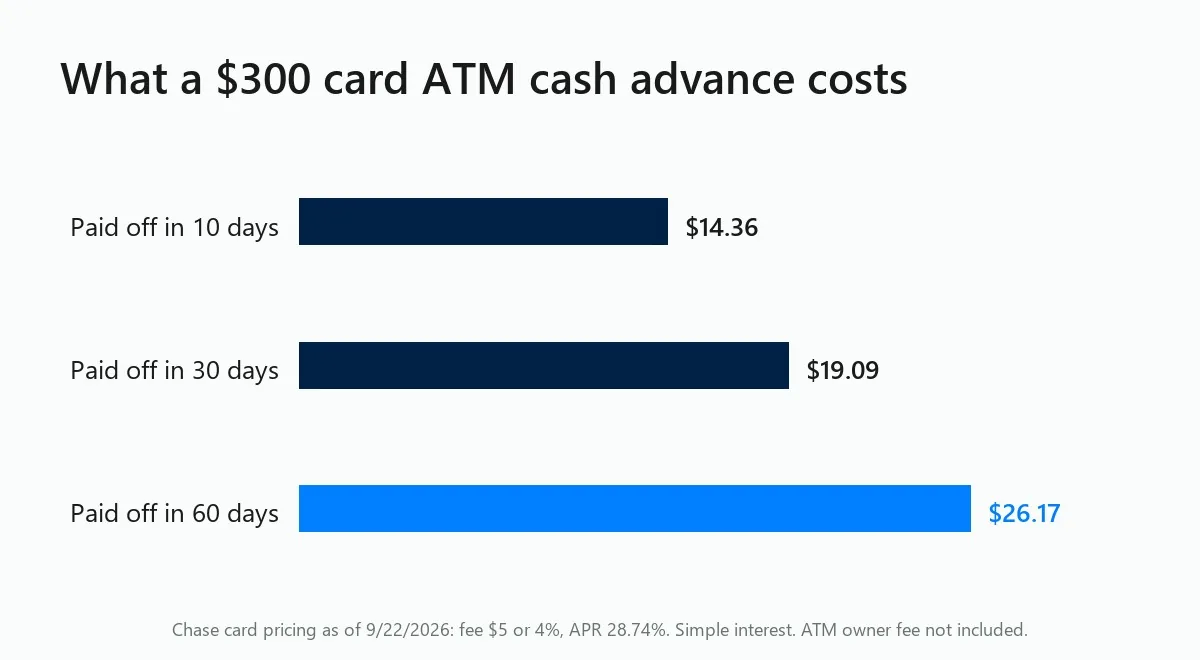
Days are the one input you control once the cash is out. At $0.2362 a day on $300 (28.74% / 365, the APR as of Sept. 22, 2026, per Chase's published pricing), 10 days of interest is $2.36 and 60 days is $14.17. With the $12.00 fee added, the card's own charges for 10, 30 and 60 days come to $14.36, $19.09 and $26.17.
That 4% formula belongs to one card, and the CFPB notes that how card cash advance fees are priced is up to the issuer: a flat fee or a percentage of the advance. To rerun the math for your own card, put its fee in step 2 and its Cash Advance APR in step 3; a separate guide has more cash advance examples worked to the penny.
Cash Advance PIN and Limit: Why the ATM Can Say No
An ATM typically asks for a PIN when you use a credit card. Capital One's guide to using a credit card at an ATM says you may have received one with the card, and if you need to create or change it, "you can typically do so by signing in to your account online." Sort out your cash advance PIN before you get to the machine.
The cash advance limit can also stop you. Your card can have "a separate lower limit for cash advances," the CFPB says, so a withdrawal can be refused while purchase credit remains. The same Capital One guide says issuers usually cap cash advances at a percentage of the credit limit; in its illustration, a $5,000 limit with a 30% cap allows $1,500, and your card's cap may differ.
Purchases can block an advance even under that cap. Capital One's cash advance explainer says that if you've used all your available credit on purchases, "you may not be able to take out a cash advance even if you haven't reached your cash advance limit." According to the same explainer, you can find cash advance limits in your card's terms or on your statement.
What to Check on Your Card Agreement Before Using an ATM
Before you go, run through these:
- The Cash Advance APR, any "accurate as of" date beside it, and the current rate on your latest statement.
- The cash advance fee formula and any minimum, applied to the amount you plan to take.
- The interest row, and what it says about when cash advance interest starts.
- Your cash advance limit, and how much of your credit line purchases already use.
- Whether you have a PIN for the card, and how to set one.
- Whether your card issuer runs the ATM, since a fee from a machine it doesn't run sits outside your agreement.
- For a debit card instead, whether you opted into your bank's overdraft coverage.
Frequently Asked Questions
Is using a debit card at an ATM a cash advance?
No. A debit withdrawal moves your own money out of your bank account, and Regulation E treats it as an electronic fund transfer. You pay no cash advance fee or interest. The ATM's owner must disclose any fee before you're committed, and your bank can charge an overdraft fee only if you opted in.
Do I need a PIN to get a cash advance from an ATM?
Typically, yes: the machine asks for your credit card's PIN before it dispenses a cash advance. If you never set one, look through what came with the card. Capital One's ATM guide says a PIN may arrive that way, and that you can typically create or change one by signing in to your account online. Do it before you go.
Does a cash advance count as a purchase?
No. Regulation Z treats purchases and cash advances as separate features, and your statement must show a separate APR and balance for each. Grace periods can differ as well: Chase's Amazon Prime Visa terms skip interest on new purchases if you pay your entire balance by the due date, and charge cash advance interest from the transaction date.
Why did the ATM decline my credit card when I still have credit available?
The CFPB says a card can have a separate, lower limit for cash advances. A withdrawal above it can be refused while purchase credit remains. Purchases also draw down the same credit line, and Capital One notes that using it all may block an advance below the cash limit. Check your terms or statement, or call your issuer.
Is the ATM owner's fee part of my card agreement?
No. Regulation Z says a charge from an institution other than your card issuer for using its ATM in a shared or interchange system is not part of the card plan, so your agreement doesn't have to disclose it. The machine's owner sets that fee; your card's own fee and Cash Advance APR are in the account-opening table.
Not a lender. Cost figures use the federal APR formula and the state rule named next to them; the state pages cite each statute. Full disclosures.